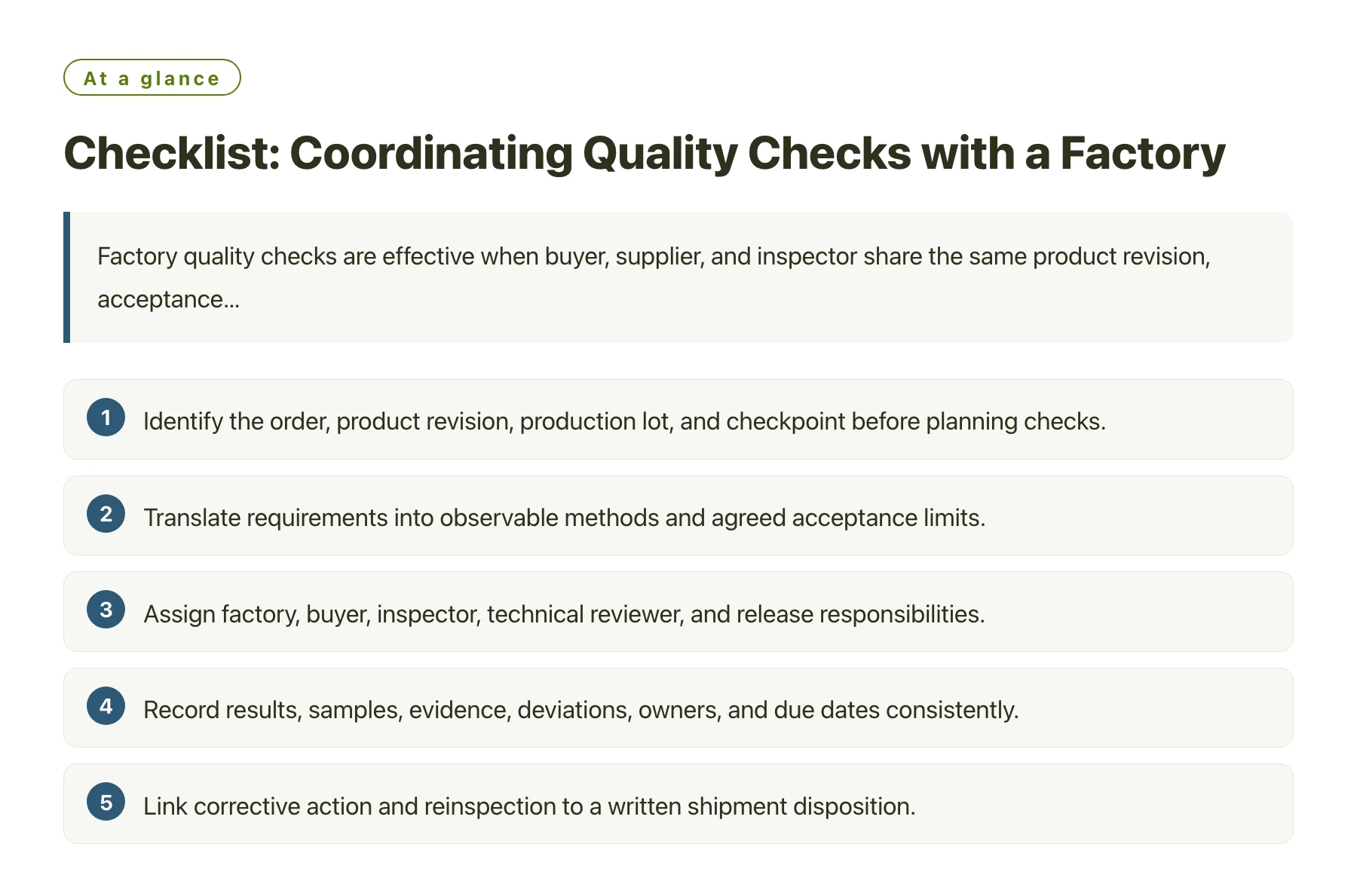
Factory quality checks are effective when buyer, supplier, and inspector share the same product revision, acceptance criteria, schedule, and escalation route. Define who checks each feature, what evidence is recorded, and who can decide whether production or shipment proceeds. Keep factory self-checks, buyer verification, third-party inspection, and formal system audits distinct. A repeatable plan reduces conflicting instructions and makes findings easier to resolve.
Key takeaways
- Identify the order, product revision, production lot, and checkpoint before planning checks.
- Translate requirements into observable methods and agreed acceptance limits.
- Assign factory, buyer, inspector, technical reviewer, and release responsibilities.
- Record results, samples, evidence, deviations, owners, and due dates consistently.
- Link corrective action and reinspection to a written shipment disposition.
Use a risk-based schedule so the most consequential product and process checks receive suitable attention.
1. Define what each check is meant to establish
Start with the purchase order, approved specification, drawings, sample, and change history. Identify the feature or process at risk and the decision the check must support. A dimension check, incoming material verification, in-process observation, final inspection, and management-system audit answer different questions. Do not use the word “inspection” as a substitute for describing scope, method, sample, and acceptance rule.
Create a check matrix by product family and risk. Include requirement reference, method, stage, sample or lot, evidence, owner, acceptance limit, and action for a failure. If a limit is missing, send it to the design or technical owner before the check begins. A field inspector should not invent tolerances or approve a safety decision outside their competence.
2. Agree timing and production readiness
Place checkpoints at stages where a finding can still change the outcome: material receipt, first production, in-process work, finished goods, packing, or loading. Select stages according to product risk and order complexity rather than automatically scheduling every possible visit. Confirm the supplier has the required quantity, documents, staff, access, and safe working arrangements ready for each visit.
State booking notice, production completion threshold, location, working hours, contact, and what happens if goods are not ready. If a check is postponed, record which work continued and whether the delay affects the next gate. Do not let an incomplete visit be recorded as a full inspection simply because a shipment date is near.
3. Make factory self-checks and independent verification distinct
Ask the factory to identify its own process controls, inspection points, records, and escalation path. Verify selected evidence against the order requirements instead of assuming that a quality certificate proves current production conformity. Decide whether independent inspection is needed and who selects and pays the inspector. If an internal or third-party auditor is used, confirm competence and independence appropriate to the task.
ISO 19011:2026 provides guidance for auditing management systems, including audit principles, programmes, and auditor competence. A management-system audit is not the same as checking a particular production lot or product characteristic; plan each activity for its intended purpose. [1]
4. Standardize evidence and sample identity
For each check, record date, location, product code, lot, drawing or sample revision, method, instrument where relevant, result, and inspector. Label samples and photographs so they can be traced to the checked requirement. Use consistent file names and link evidence to the order or nonconformance number. A photograph can support a finding but does not replace a measurement, functional test, or document review when those are required.
Specify whether samples are selected by the buyer, supplier, or inspector and how many are examined. If the project uses an acceptance sampling plan, state the standard edition, inspection level, lot definition, and defect categories in advance. Record deviations from that plan and obtain approval. Do not report an untested property as verified because a visually similar feature was checked.
5. Coordinate communication on the factory floor
Name one buyer contact to consolidate instructions and one factory contact who can answer or escalate. Give the supplier the current checklist, product revisions, and visit plan before work begins. Use short written instructions with an item identifier, requested action, owner, and deadline. Avoid sending conflicting changes through separate buyer, designer, and quality channels without a shared record.
When a discrepancy appears, identify the affected quantity and containment action promptly. Separate confirmed facts from interpretation and proposed disposition. Escalate immediately when a finding could affect safety, legal compliance, another lot, or shipment release. Keep a time-stamped record of who was notified and whether production was paused, segregated, or allowed to continue under an approved condition.
6. Manage findings through corrective action
Give each finding a unique reference and identify requirement, observed result, product or lot, evidence, severity, owner, and due date. Ask the supplier to contain affected goods before proposing a long-term correction. Where root-cause analysis is appropriate, request a cause supported by evidence, not just a statement that staff will be reminded. Define how the buyer will verify implementation and check for recurrence.
A correction or rework should be checked against the original requirement. Record quantities repaired, scrapped, replaced, or accepted under deviation, and whether reinspection is needed. Preserve both original and follow-up findings so a closed corrective action does not erase the initial condition. Set a clear rule for when an issue is considered closed and who can accept residual risk.
7. Control changes and shipment release
Require the factory to raise changes to materials, supplier, equipment, process, work site, software, drawing revision, or packaging before applying them to the order. Review whether a change affects a test, approved sample, certificate, fit, function, or delivery plan. Record approval scope and effective date, then update checklists and instructions sent to the factory and inspector.
At the final gate, summarize open findings, document status, quantity inspected, and evidence limitations. Name the person authorized to release shipment and state any conditions for release. A passed sample check should not override a failed critical test or unresolved mandatory document. Keep the disposition with the inspection report and shipping record so logistics teams do not infer approval from a booking confirmation.
8. Review the system after each order
After delivery, compare planned and actual inspection dates, finding rates, response time, repeat issues, and corrective-action closure. Look for gaps such as late criteria, inaccessible production, missing lot identity, unclear responsibilities, or repeated requests for the same evidence. Use the review to adjust the next order’s checkpoints, staffing, or technical support rather than adding checks without a defined purpose.
Keep supplier feedback specific and actionable. Distinguish a one-off handling incident from a repeated process pattern, and recognize verified improvements without assuming they remove future verification needs. Buyers coordinating Shanghai JS Sourcing can maintain a shared quality plan that connects supplier instructions, inspection records, and release decisions for each order.
Sources
Frequently asked questions
When should factory quality criteria be agreed?
Agree requirements, methods, sample rules, and acceptance limits before production reaches the relevant checkpoint. Route missing technical criteria to the authorized owner before asking an inspector to judge them.
Does an ISO management certificate prove a shipment is defect-free?
No. It applies to a management-system scope and does not establish that every product or lot meets a buyer’s specification. Use product-specific checks and evidence as needed.
Who should approve a factory deviation?
The buyer’s designated technical or commercial decision owner should approve within their authority. Record the affected product, reason, evidence, conditions, and effect on release.
What makes an inspection finding ready to close?
Document the correction or disposition, affected quantity, supporting evidence, verification result, and authorized closure. Keep unresolved or conditional items visible until their conditions are met.