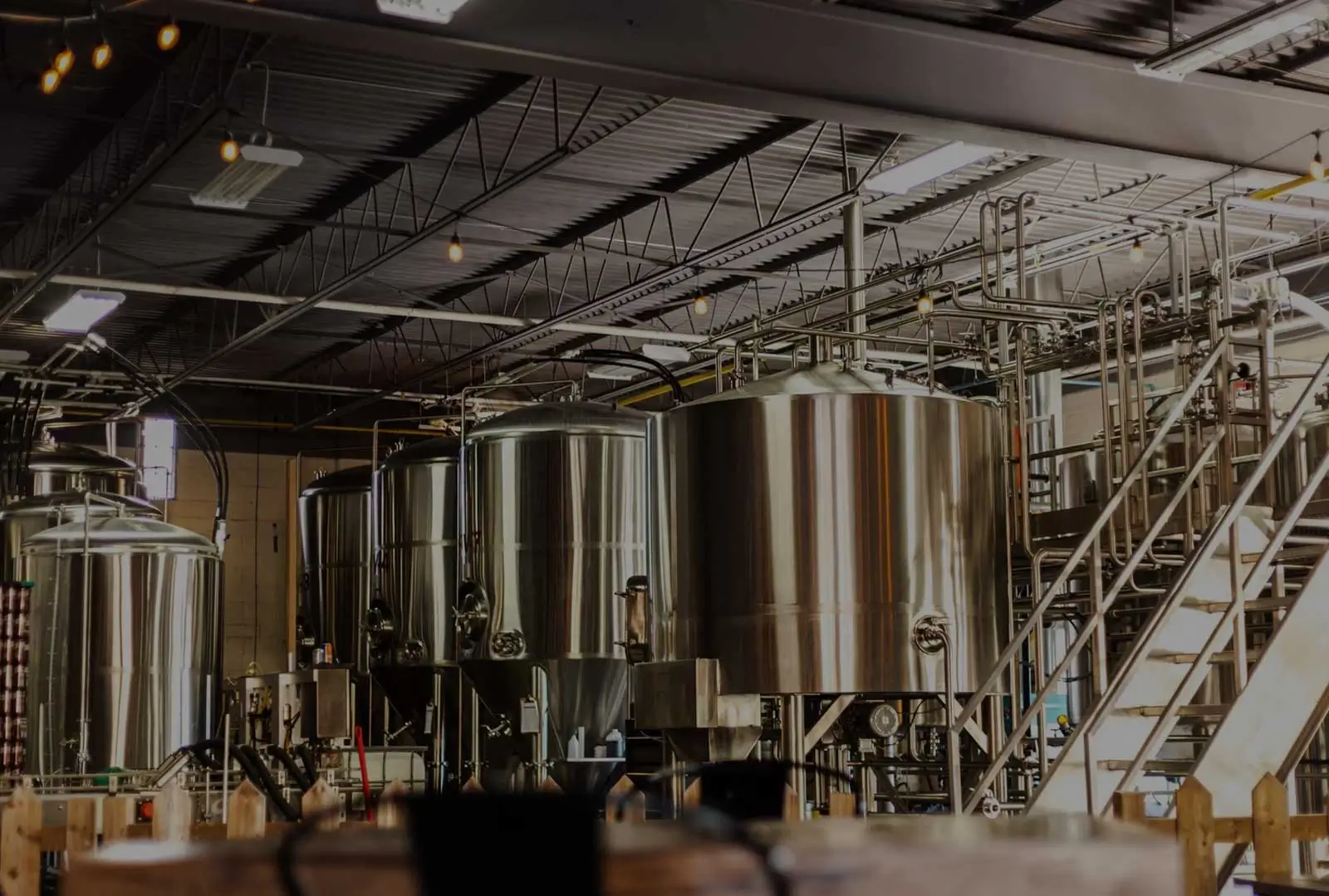
Long service life starts with measurable maintenance rather than repair after failure. Keep product-contact stainless steel free of organic soil, inspect seals and valves on a fixed cycle, record pump pressure and flow, and compare heat-exchanger inlet and outlet temperatures after each production run. The Brewers Association recommends cleaning draught lines at least every 14 days, using 2% caustic for well-maintained lines, with at least 15 minutes of circulation. Tanks, pumps, chillers, instruments, and pressure devices need separate service intervals because temperature, chemicals, operating hours, and water hardness wear each component differently. A written record makes gradual performance loss easier to identify.
A brewery should begin with surfaces that touch wort or beer because residue left inside a tank, pipe, valve, hose, or pump can remain even when the visible vessel wall looks clean. The 2022 FDA Food Code describes a basic sanitation sequence: remove organic material first, clean the surface properly, then apply sanitizer at the specified concentration, temperature, and contact time. That sequence provides a useful maintenance principle for brewing equipment as well: cleaning chemistry works better when soil removal, rinsing, and sanitation are treated as separate jobs rather than one chemical step.
Cleaning concentration should be measured rather than estimated by sight. The Brewers Association's draught guidance specifies 2% caustic for routine cleaning of maintained beer lines and 3% for older or more difficult systems, with solution temperatures between 80°F and 110°F. Pump circulation should continue for at least 15 minutes; static cleaning requires no less than 20 minutes. Although tank and brewhouse CIP procedures require equipment-specific settings, the same control method applies: document concentration, temperature, circulation time, return condition, and final rinse result for every established program.
A clean-looking stainless surface is not enough. Chemical concentration, contact time, temperature, mechanical circulation, and complete rinsing should all be verified because changing one condition can change cleaning performance.
That measurement approach leads naturally to stainless-steel care. Most brewery tanks and piping use corrosion-resistant stainless steel, but repeated exposure to incompatible cleaners, chloride-rich water, surface contamination, and physical abrasion can reduce surface condition over years of service. Do not use ordinary carbon-steel wool or brushes on product-contact stainless steel, and investigate brown staining or localized pitting instead of polishing it away repeatedly. After fabrication, grinding, welding, or certain repairs, follow the vessel manufacturer's cleaning and passivation instructions before returning the equipment to beer production.
Connections deserve the next inspection because sanitary performance depends on more than the vessel shell. Tri-clamp gaskets, O-rings, valve seats, mechanical seals, diaphragms, and manway seals experience compression, heat, chemical exposure, and repeated assembly. In a brewery running 5 production days per week, a gasket opened once per production day can experience roughly 250 assembly cycles per year. Inspect removed elastomers for flattening, cuts, swelling, hardness changes, surface cracking, and permanent deformation rather than assigning replacement by age alone.
Material selection also matters. EPDM, FKM, silicone, PTFE, and other sealing materials do not have identical resistance to temperature and cleaning chemicals, so replacement parts should follow the original equipment specification. A seal that fits physically may still have unsuitable chemical resistance. Keeping verified part numbers beside the maintenance record reduces substitution errors, especially when several fermenter, pump, and valve models are installed in the same brewery.
Once seals are controlled, pump condition becomes easier to judge because leaks and unstable flow are no longer mistaken for gasket problems elsewhere. Record discharge pressure, approximate transfer time, unusual noise, seal leakage, and motor condition under repeatable operating conditions. A transfer that previously moved 1,000 liters in 20 minutes but later needs 25 minutes has taken 25% longer; that change deserves inspection of the impeller, suction path, valves, strainers, seal condition, and process setup before a pump stops during production.
A simple inspection routine can cover the items most likely to reveal wear without dismantling equipment unnecessarily:
-
Before production: check visible leaks, tank pressure, cooling response, pump seals, valve movement, and abnormal sound.
-
After cleaning: inspect accessible gaskets, sample valves, spray devices, fittings, hoses, and drain points for residue or trapped liquid.
-
Monthly or by operating hours: review pump performance, glycol concentration, electrical enclosures, insulation, sensor readings, and spare-part stock.
-
At manufacturer-defined intervals: service gearboxes, pressure devices, motors, actuators, heat exchangers, and calibrated instruments.
Heat exchangers benefit from the same trend-based approach. Alfa Laval recommends checking changes in temperature and pressure and inspecting for external leakage daily on gasketed plate heat exchangers; its maintenance guidance also recommends recording service history and cleaning plates according to media, temperature, and operating conditions. Comparing data from similar brews is more informative than waiting for cooling to become obviously slow.
For example, if wort normally enters a plate exchanger at 95°C and leaves at 20°C under a repeatable water flow, an outlet temperature that gradually rises to 24°C deserves investigation. Fouling, restricted coolant flow, trapped air, scaling, or changed flow conditions may all produce weaker heat transfer. Alfa Laval recommends filters or strainers to reduce particulate fouling and states that CIP can clean a plate exchanger without repeated opening. In a 2026 Alfa Laval service case, 14 heat exchangers were integrity-tested and all required repair, illustrating why internal condition cannot always be judged from the exterior.
Cooling performance then connects to the glycol system. Fermenters may appear mechanically sound while poor refrigeration control increases cooling time across several vessels. Record glycol supply temperature, return temperature, reservoir level, pump condition, and visible condensation. Check insulation around valves and pipe joints because wet insulation can conceal leakage and reduce thermal performance. Glycol concentration should be measured with an appropriate instrument and maintained according to the chiller manufacturer's required freeze protection rather than topped up by estimating water and glycol volumes.
| Equipment area | Record during service | Investigate when |
|---|---|---|
| Fermenter | pressure, temperature, gasket condition | readings drift or seals deform |
| Pump | pressure, transfer time, leakage | transfer time rises 10–20% under similar conditions |
| Heat exchanger | inlet/outlet temperature, pressure | cooling time or pressure drop changes |
| Glycol loop | supply/return temperature, concentration | tanks take longer to reach setpoint |
| Valve | movement, seat condition, leakage | movement becomes stiff or incomplete |
| Instrument | reference reading, deviation, calibration date | deviation exceeds the site's approved tolerance |
Instrumentation should be checked before operators begin compensating for bad readings. A temperature probe that reads 1°C high can still look believable on a fermenter display, while repeated manual adjustments may move the actual beer temperature away from the intended setpoint. Calibration records should contain equipment ID, reference instrument, as-found reading, adjustment, as-left reading, date, and technician. Instead of assigning the same annual schedule to every instrument, base frequency on manufacturer guidance, use frequency, previous calibration results, and the effect of a wrong reading.
Pressure equipment needs a different service approach because inspection involves rated operating limits and safety devices. Never block, modify, or substitute a pressure-relief or vacuum-protection device to solve a production inconvenience. Fermenters, bright tanks, regulators, gauges, relief devices, and connected piping should remain within the manufacturer's rated conditions, while local inspection rules and applicable pressure-vessel requirements take priority over a generic maintenance calendar.
A pressure gauge showing a normal number does not confirm that the relief device beside it will operate correctly. Gauges, regulators, relief devices, and vacuum protection perform different functions and need their own inspection requirements.
Maintenance planning becomes easier when the brewery is specified as one system instead of a collection of individual machines. Suppliers offering Turn-Key brewery solutions can coordinate tanks, piping, pumps, heat exchange, refrigeration, controls, and filling equipment, but long service life still depends on documented maintenance after installation. Equipment manuals, material specifications, spare-part numbers, electrical drawings, and rated operating limits should remain available to the people servicing the plant.
Spare-parts planning should follow actual wear history. If a brewery operates 50 weeks per year, losing even 4 hours every 10 weeks to the same seal or solenoid problem creates about 20 hours of repeat downtime annually. Keep approved pump seals, valve seats, sanitary gaskets, diaphragms, temperature probes, fuses, and model-specific components where supplier lead time could interrupt production, while expensive low-failure parts can remain supplier-stocked where delivery time is acceptable.
Maintenance records turn those individual repairs into comparable data. For each event, record date, equipment ID, operating hours or cycle count when available, symptom, measured condition, part number, work performed, technician, and next inspection date. Alfa Laval also recommends recording heat-exchanger maintenance, while the Brewers Association recommends clearly posted cleaning documentation for draught systems. Records should use measured descriptions such as “transfer time increased from 18 to 23 minutes” rather than “pump running poorly.”
Draught equipment can use an especially clear calendar because the Brewers Association publishes defined intervals. Its guidance calls for line cleaning at least every 14 days, quarterly acid cleaning in addition to routine caustic cleaning, and hand cleaning and servicing of specified hardware every 6 months. Its 2025 training material also recommends 2–3% caustic at 80–110°F, at least 15 minutes for pump cleaning, and replacement of certain jumper and direct-draw lines yearly.
Chemical safety belongs in the same written procedure. The Brewers Association's 2024 sodium-hydroxide guidance describes caustic as a strong cleaning and degreasing chemical and stresses appropriate personal protective equipment. Never mix cleaning chemicals unless the chemical supplier's documented procedure specifically requires it. Confirm final rinsing by the approved site method; Brewers Association draught guidance calls for flushing until rinse-water pH matches the incoming water and visible debris is gone.
Equipment condition should finally be compared against production history rather than calendar age alone. A brewhouse operating 2 batches per week completes about 100 batches in 50 working weeks, while a system operating 10 batches per week approaches 500 batches in the same period. Pumps, valves, heating surfaces, seals, and CIP circuits in the second brewery experience far more cycles, so identical yearly maintenance intervals may produce very different wear. Operating hours, batch count, cleaning cycles, repair frequency, and measured performance give a more useful basis for adjusting future service intervals.